
BEAVAR
Construction Laboratory for the Development and Training of Sustainable Methods in Automation and Robotics
Climate change and resource scarcity demand new solutions and ways of thinking in the construction sector: the construction industry is responsible for around 40 percent of global CO₂ emissions, generating an urgent need for ecological, energy-efficient construction methods with significantly reduced CO₂ output. At the same time, an acute housing shortage means Germany requires almost 400,000 new dwellings every year.
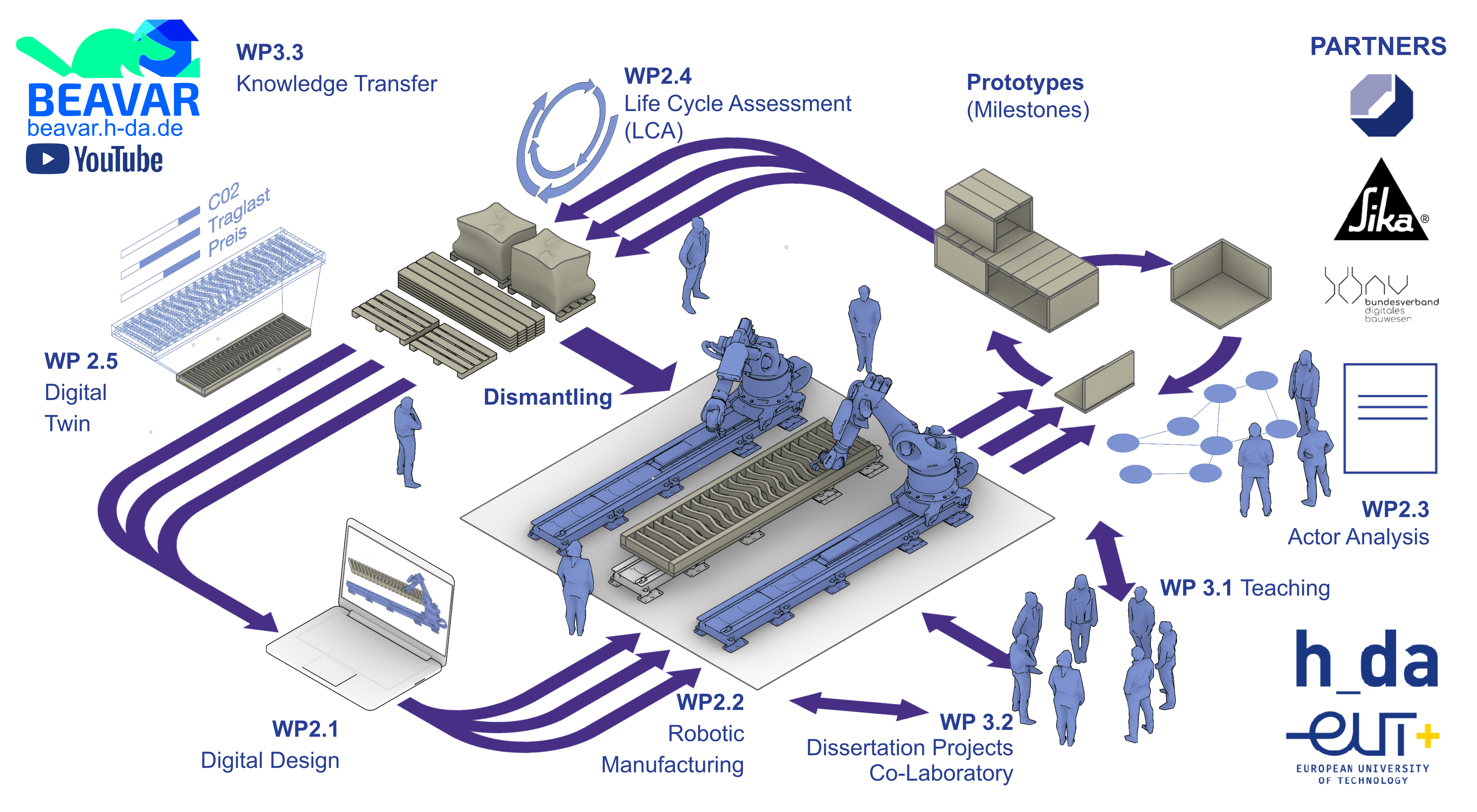
In the project "Baulabor für Entwicklung und Ausbildung zu nachhaltigen Verfahren der Automatisierung und Robotik" (BEAVAR — Construction Laboratory for the Development and Training of Sustainable Methods in Automation and Robotics), Darmstadt University of Applied Sciences (h_da) is establishing a robotic construction laboratory for sustainable and circular building, in which modular, robotically fabricated hybrid construction methods are researched and taught at full scale (1:1). Seven professors from six departments collaborate across three thematic clusters: Construction and Materials, Robotics and Control, and Evaluation and Lifecycle. The focus is on small and medium-sized enterprises (Mittelstand) in the construction industry — together with industry partners, the project seeks to accelerate innovation, transfer sustainable construction methods into everyday practice, and demonstrate their economic viability.
The research space, equipped with state-of-the-art industrial robotics and associated peripherals funded by the German Federal Ministry of Education and Research (BMBF) and the Joint Science Conference (GWK), serves the investigation and processing of sustainable building materials at full scale through prototypes and demonstration projects carried out together with academic and industry partners. It is complemented by an approximately 300 m² construction field, on which experimental building projects can be realised and tested under realistic conditions. Two cooperating industrial robots enable additive and subtractive manufacturing techniques for processing materials such as clay, timber, geopolymers, paper, and hemp-lime. The objective is to develop resource-efficient, high-performance load-bearing systems for circular net-zero buildings made from climate-friendly materials; demountable joint details ensure that components can be separated and reused. In parallel, components and processes are evaluated ecologically through a life cycle assessment (LCA), while a social-science stakeholder analysis identifies incentives and barriers to practical implementation.
The robotic laboratory is further complemented by a co-laboratory accommodating up to five research associates and doctoral candidates, who work there in an interdisciplinary manner and in close cooperation with industry partners. The research space is at the same time a teaching laboratory: as part of the qualification concept, the construction laboratory offers students and doctoral candidates direct access to an innovative experimental environment with new robotics and metrology equipment. Master's students and doctoral candidates work directly on the systems through seminars and project-based formats, acquiring transdisciplinary competencies in digital planning, robotic fabrication, and sustainable construction methods.
Project data:
Funding period: 1.10.2025 – 31.09.2029
Funding volume: 2.329.976€
Interdisciplinary project partners at h_da:
Prof. Dr.-Ing. Bastian Wibranek
Department of Architecture (Project lead, Thematic Cluster cD)
Digital Planning, Construction and Fabrication, Architectural Design
Prof. Dr.-Ing. Albrecht Gilka-Bötzow
Department of Civil and Environmental Engineering (Thematic Cluster cD)
Building Materials Science and Building Materials Laboratory
Prof. Dr.-Ing. Andreas Büter
Department of Mechanical and Plastics Engineering (Thematic Cluster cD)
Function-integrated Lightweight Construction, Engineering Mechanics and Aerodynamics
Prof. Dr.-Ing. Iris Steinberg
Department of Civil and Environmental Engineering (Thematic Cluster cN)
Circular Economy and Environmental Assessment
Prof. Dr Daniel Feser
Department of Social Sciences
(Thematic Cluster cN)
Risk and Sustainability Sciences
Prof. Dr Stephan Neser
Department of Mathematics and Natural Sciences
(Thematic Cluster cR)
3D machine vision, robot vision and photogrammetry
Prof. Dr.-Ing. Alexandra Weigl-Seitz
Department of Electrical Engineering and Information Technology
(Thematic Cluster cR)
Robotics and Control Engineering
Alexander König
Department of Electrical Engineering and Information Technology
(Thematic Cluster cR)
Robotics and Control Engineering